Make Money Simply
Private Money Lending for Fix and Flip Investors: The Complete Guide
F ix-and-flip investing and private money lending were made for each other. The speed and flexibility of private money aligns perfectly with the fast-moving, time-sensitive nature of house flipping. Here’s everything you need to know.
Why Fix-and-Flip Investors Use Private Money
Banks won’t lend on distressed properties. Bank loans take 30–60 days to close. And banks certainly won’t fund renovation costs. Private money solves all three problems: it funds the purchase, covers part of the rehab, and closes in days not weeks.
The Typical Fix-and-Flip Loan Structure
Most private lenders fund fix-and-flip deals using one of two approaches:
Option A: Purchase + Rehab Hold-Back
- Lender funds 100% of the purchase price (up to 70% LTV)
- Renovation funds are held in reserve and released in draws as work is completed
- Borrower submits draw requests with photos and receipts
Option B: Purchase Only (Borrower Self-Funds Rehab)
- Lender funds only the purchase (lower LTV, lower rate)
- Borrower uses their own cash for renovations
- Lower cost but requires more capital reserves
Running the Numbers: Fix-and-Flip Deal Example
- Property: $100,000 purchase price
- Renovation Budget: $30,000
- ARV: $185,000
- Private Money Loan: $100,000 at 10% for 9 months
- Points: 2 ($2,000)
- Monthly Interest: $833
- Total Carrying Cost: $7,497
- Sale Price: $185,000
- Profit After All Costs: ~$35,000+
What Lenders Look at in Fix-and-Flip Deals
- Purchase price vs. ARV (looking for 70% rule or better)
- Detailed, itemized renovation budget
- Your exit strategy (list date, listing agent, target sale price)
- Your track record on previous flips
- The local comparable sales (comps) supporting the ARV
Rehab Draw Schedules: How They Work
When lenders include rehab funds, they’re released in stages:
- Draw 1: 25% of rehab budget (foundation, framing complete)
- Draw 2: 50% completion (rough plumbing, electrical done)
- Draw 3: 75% completion (drywall, HVAC complete)
- Final Draw: Property 100% complete and ready for sale
Each draw requires an inspection or photo documentation.
Common Mistakes Fix-and-Flip Investors Make
- Over-estimating ARV (be conservative)
- Under-estimating renovation costs (add 15–20% buffer)
- Not having an exit strategy before borrowing
- Choosing a lender based on rate alone (relationship and reliability matter)
- Missing the draw schedule documentation requirements
Finding Private Money for Your First Flip
Start with your personal network, local REI meetups, and BiggerPockets. Bring a deal package showing your purchase price, renovation plan, comparable sales, and projected profit. Even without a track record, a compelling deal can get funded.
Get the full foundation: private money lending basics, how to find private money lenders, and how to pitch private money lenders.
Private Money Lending Rates: What to Expect in 2026
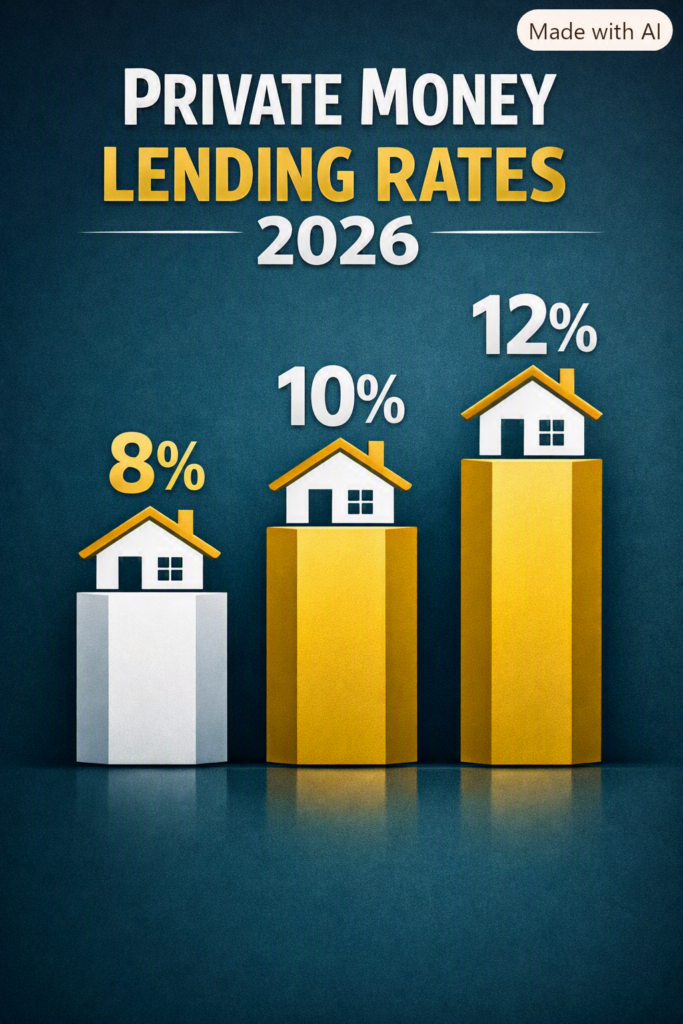 One of the first questions real estate investors ask about private money is: “How much does it cost?” Understanding private money lending rates helps you accurately analyze deals and negotiate better terms. Here’s a complete breakdown.
What Are Typical Private Money Lending Rates?
In 2026, private money lending rates typically range from 8% to 13% annually, depending on:
- The lender’s risk tolerance and relationship with the borrower
- The property type and condition
- The loan-to-value ratio (LTV)
- The loan term and exit strategy
- The borrower’s track record
Interest Rate Breakdown by Property Type
- Fix-and-Flip (residential): 9–12%
- BRRRR Rentals: 9–11%
- Commercial Bridge: 10–13%
- Land Loans: 10–14%
- New Construction: 10–13%
What Are “Points” in Private Lending?
Points are origination fees charged upfront. One point = 1% of the loan amount. Private lenders typically charge 1–3 points. On a $200,000 loan at 2 points, you’d pay $4,000 at closing.
How LTV Affects Your Rate
The lower your LTV, the lower your rate. A 60% LTV loan carries less risk than an 80% LTV loan—lenders reward less risk with lower rates. Most private lenders cap LTV at 70–75%.
How Borrower Track Record Affects Rate
First-time borrowers typically pay higher rates (10–12%). Repeat borrowers with a proven track record often negotiate down to 8–9%. Your credibility has real monetary value.
Comparing Private Money to Hard Money
Hard money lenders typically charge 11–14% with 2–4 points. Private individual lenders often charge 8–10% with 1–2 points. Over a 12-month, $200,000 loan, that difference is $6,000–$8,000 in savings.
How to Negotiate Better Rates
- Bring a strong deal with conservative numbers
- Show your track record and references
- Offer a lower LTV (more equity cushion for the lender)
- Offer a personal guarantee
- Start with one solid deal and build the relationship
Are Private Money Rates Worth It?
Yes—when the deal math works. If you’re buying a property at $0.70 on the dollar with strong ARV, the 10% interest rate is a cost of doing business, not a dealbreaker.
Want to learn how to structure a deal around these rates? Read how to structure a private money lending deal and how to analyze a fix-and-flip deal.
How to Find Private Money Lenders for Real Estate Investing

The Smartest Ways to Connect With Private Money Lenders
One of the most common questions new investors ask is: “Where do I find private money lenders?” The answer might surprise you—they’re closer than you think. Here’s a proven roadmap.
Start With Your Existing Network
Your first private lenders are often people who already know, like, and trust you. Consider: family members with savings, business colleagues with disposable capital, friends who complain about low CD or savings rates, former colleagues, and your dentist, doctor, or accountant.
You’re not asking for a gift—you’re offering them a secured, collateralized investment at 8–10% returns. That’s a compelling offer.
Real Estate Investor Meetups (REI Clubs)
Local REI meetups are goldmines for private money connections. Attend consistently. Share your deals. As people see you executing, they’ll naturally ask about investing with you. Find local meetups at Meetup.com, BiggerPockets Events, or your local REIA (Real Estate Investors Association).
Online Platforms
Several platforms connect borrowers with private lenders:
- BiggerPockets forums and marketplace
- Connected Investors platform
- PeerStreet (institutional private lending)
- Groundfloor (retail lender marketplace)
- LinkedIn (search “private lender real estate”)
Build a Credibility Package First
Before approaching any lender, have a professional credibility package ready:
- Your investing bio and track record
- Sample deal analysis (with real comps)
- References from past deals
- A clear explanation of how the loan is structured and secured
Real Estate Attorneys and Title Companies
Attorneys who handle real estate closings know who has capital. Title companies see who funds deals repeatedly. Build relationships with these professionals—they can refer you to lenders who are actively looking for deals.
Self-Directed IRA Holders
Millions of Americans have self-directed IRAs that can legally invest in real estate loans. These individuals are actively looking for higher returns than the stock market offers. Connect with custodians like Equity Trust or STRATA Trust Company.
The Art of the Ask
When approaching a potential lender, never lead with “I need money.” Lead with: “I found a great deal and I’m building my investor network. Would you be open to a conversation about how I structure deals?” Educate first, ask second.
CTA: Once you find a lender, you’ll need to know how to structure a private money deal and how to pitch private money lenders. We’ve got both covered.
What Is Private Money Lending? A Complete Beginner’s Guide
 If you’ve ever heard the term “private money lending” and wondered what it actually means—you’re in the right place. Whether you’re a real estate investor looking for flexible financing or someone with capital looking to earn better returns, understanding private money lending basics is the first step.
What Is Private Money Lending?
Private money lending is when an individual (not a bank or credit union) loans money to a real estate investor, secured by the property itself. Unlike traditional bank loans, private money loans are funded by private individuals—often other investors, high-net-worth individuals, or those using self-directed IRAs.
The loan is typically secured by a deed of trust or mortgage on the property, giving the lender a legal claim to the asset if the borrower defaults.
How Does Private Money Lending Work?
The process is simpler than you might think:
- A borrower (investor) identifies a property deal.
- They approach a private lender with a deal package.
- The lender evaluates the deal—primarily based on the property value and exit strategy.
- Terms are negotiated: interest rate, loan term, points, and repayment structure.
- Both parties sign a promissory note and deed of trust.
- Funds are wired, the deal closes, and the lender earns interest.
Who Uses Private Money Lending?
- Fix-and-flip investors who need fast funding
- BRRRR investors building rental portfolios
- Real estate wholesalers who double-close deals
- New investors who can’t qualify for bank loans
- Experienced investors who need to close quickly
Private Money vs. Hard Money vs. Conventional Loans
Private money lenders are typically individuals with capital. Hard money lenders are companies that operate similarly but at scale. Conventional loans come from banks and require strict qualification. Private money sits between personal relationships and institutional lending—offering flexibility, speed, and negotiable terms.
Why Private Money Lending Matters
Speed and flexibility are the biggest advantages. Banks take 30–60 days to close. Private lenders can fund in 7–14 days. That speed wins deals in competitive markets.
Typical Private Money Loan Terms
- Loan-to-Value (LTV): 65–80%
- Interest Rates: 8–12% annually
- Loan Term: 6–24 months
- Points: 1–3 origination points
- Repayment: Interest-only with balloon payment
Is Private Money Lending Legal?
Yes. Private money lending is legal in all 50 states. However, there are regulations around how many loans a private lender can make before they’re required to obtain a lending license. Always consult a real estate attorney.
Getting Started with Private Money Lending Basics
Whether you’re the borrower or the lender, start by educating yourself on deal structures, legal requirements, and how to evaluate properties. The rest of this blog series breaks each topic down in detail.
CTA: Ready to learn more? Explore our full guide on how to find private money lenders and how to structure a private money deal.
How I Make Money With Credit and Turn It Into a Legitimate, Lender‑Friendly Business
 When I first heard that you could make money with credit, I was immediately hooked. I read books, watched videos, and scrolled through countless forums to learn everything I could about building personal credit and business credit.
I know how to get high scores and I know how to get credit. What I didn’t have was a legitimate business with a clear plan—something that turns knowledge into profit and qualifies for real funding.
How I Make Money With Credit
I discovered options trading and learned how to sell options for income. But turning that into a business recognized by the IRS is extremely difficult. Banks consider trading risky, so getting funded for that purpose is unlikely.
That’s when I realized something important: turning experience and knowledge into internet content *is* a business. It’s legitimate, fundable, and lender-friendly.
I use AI to help me create content about credit. I monetize that content with Adsense so I earn money when visitors click on ads. I also use AI to help me choose the right NAICS codes, avoid high-risk industries, and stay out of the danger zone with lenders.
My trading strategy doesn’t require much time. That gives me room to report on what’s working, what’s profitable, and how I’m growing my credit limits. I share how I organize my finances, how I manage my trades, and how I build my business credit.
Building Business Credit the Right Way
All of this drives me to create. It helps me, and it helps others. When gurus say they “do it to help people,” I think this is what they mean.
Whether or not my digital marketing business succeeds isn’t the point. What matters is that it pays for what I’m really interested in: the credit.
I sell cash-secured puts using the wheel strategy, and it’s working well for me. Writing blog posts, making Pinterest pins, and posting about credit gives legitimacy to everything I’m doing. That legitimacy helps me get more credit, sell more puts, handle wins and losses, and report on it all with useful content that earns Adsense income and grows my investment accounts faster.
My main job is simple: sell cash-secured puts and manage the results at option expiration.
This newsletter and blog exist to talk about building personal credit and leveraging it into business credit. Business credit offers much higher limits, which allows you to grow exponentially.
Right now, I’m mostly building for SEO. That will help with Adsense income too. It’s all connected.
Once traffic and income start growing, I’ll expand the email newsletter and build more momentum.
It’s all a work in progress, and that progress becomes the content. People want to know what you’re trying, whether it worked, what you changed, and what improved.
A digital marketing or consulting business is exactly what lenders like. Reporting on this journey makes it legitimate. Finally, all the pieces are lining up, and I’m making real progress.
You can also read more in my Credit Optimization section: https://gilberthernandez.com/category/credit-optimization/
Simple Online Task for Real Estate Down Payment
 Most people think they need a big job, a big credit score, or a big break to get into real estate. They don’t. They need small, predictable cash flow that stacks consistently.
This simple online task for real estate down payment is the fastest way beginners create the cash they need for their first deal.
A simple online task can generate that cash flow. It isn’t glamorous or fast, but it quietly builds the money you’ll later use for your first deal.
This post continues the Make Money Simply series.
Small Daily Output → Real Estate Entry
You don’t need $20,000 to start. You need $10–$20 a day. A basic online task can produce that amount. It’s not life‑changing money, but it is deal‑changing money.
In real estate, the first $3,000–$7,000 matters more than the next $70,000. It covers earnest money, inspections, closing costs, small rehabs, and liquidity proof. Small money creates leverage.
Simple Online Task for Real Estate Down Payment: The Numbers
The Math That Makes This Work
Here’s what consistent daily output looks like:
- $10/day → $300/month → $3,600/year
- $20/day → $600/month → $7,200/year
That range is enough for a down payment in many markets. It can also fund a small rehab, support a slow flip, or build reserves for private lending. Small numbers matter because they unlock real estate mechanics.
How This Connects to Real Estate
As a result, small predictable income becomes leverage. When I started, I didn’t have large capital. I had small online income streams that funded my first earnest money deposit, inspection, slow flip, seller‑financed deal, and private loan.
The task itself wasn’t special. The cash flow was predictable. Predictability is the real advantage. Banks like it, sellers like it, and private lenders like it. Most importantly, it gives you options.
This simple online task for real estate down payment works because it creates predictable daily cashflow.
Your First Step Today
Most beginners overlook how a simple online task for real estate down payment can replace months of saving.
Choose one simple online task that pays daily or weekly. It should require no skill, no startup capital, no brand, and no followers. Your goal isn’t to “make money online.” Your goal is to fund your first real estate move.
What Happens Next
Once you save $3,000–$7,000 from a simple online task, you unlock:
- seller financing
- slow flips
- private lending
- micro BRRRR deals
- small rehabs
- land plays
- mobile home flips
- down payments on low‑cost properties
Beginners get in through small, consistent cash flow. Not through credit hacks, massive income, or luck. Through predictable output that compounds into real assets.
Next Post Preview
In the next article, I’ll show you how I used this exact system to acquire a property without using my own credit.
How Simple Tasks Lead to Using Other People’s Money to Buy Cash‑Flowing Assets
Up to now, we’ve talked about simple online tasks, tiny wins, and building momentum. But today we’re shifting into something bigger — the real system I use in my own life. The system that takes me from small online wins to buying assets with other people’s money, letting the asset pay for itself, and keeping the profit.
This isn’t complicated.
It isn’t risky.
And it isn’t something reserved for experts.
It’s a simple progression: small wins → confidence → credit → assets → cash flow.
Let’s break it down.
—
PEOPLE TRY TO BUY ASSETS WITH THEIR OWN MONEY
Most beginners think they need a pile of cash to buy assets.
They think they need:
• Thousands saved
• A perfect plan
• A big portfolio
• Years of preparation
But that’s not how real wealth is built.
Real wealth is built by using other people’s money to acquire assets that pay for themselves.
This is the part nobody teaches beginners — because it sounds too simple.
—
USE CREDIT AS CAPITAL (NOT AS DEBT)
Here’s the mindset shift that changed everything for me:
Credit isn’t debt when the asset pays for the credit.
That’s the entire game.
When you use business credit to fund a cash‑flowing asset, you’re not “borrowing money.” You’re **leveraging capital**.
The asset pays the bill.
You keep the spread.
And your credit limits grow.
This is how I run the wheel strategy.
—
BUY ASSETS THAT PAY FOR THEMSELVES
Here’s how the wheel strategy fits perfectly into using other people’s money:
1. I build business credit
2. I use that credit as capital
3. I sell cash‑secured puts
4. I acquire shares at a discount
5. I sell covered calls
6. The premiums pay the credit
7. The asset grows
8. The profit is mine
The stock becomes the asset.
The premiums become the cash flow.
The credit becomes the fuel.
This is the simplest form of asset‑based leverage most people will ever encounter.
And it works.
—
SIMPLE TASKS BUILD THE CONFIDENCE TO LEVERAGE CAPITAL
The reason I start people with simple online tasks is because they build the one thing you need before using OPM: **momentum**.
Momentum makes credit feel less scary.
Momentum makes assets feel achievable.
Momentum makes leverage feel logical.
You don’t jump straight into buying assets with other people’s money.
You build the habit of taking small, repeatable actions.
Then you scale those actions with capital.
That’s the real system.
—
YOUR NEXT STEP (THE ONE THAT OPENS THE DOOR)
In the next post, I’ll show you how to start building business credit the simple way — without forming a complicated business, without creating a job, and without needing a huge plan.
This is the bridge between tiny online wins and buying assets with other people’s money.
Next post: Building Business Credit the Simple Way
Turning Simple Online Tasks Into Steady Income
Most people think income comes from big plans, big systems, or big commitments. But steady income doesn’t start big. It starts small — with simple online tasks that you repeat until they become a reliable flow.
In the last post, I showed you the simple online activity anyone can start today. Now I’m going to show you how that tiny action becomes something much bigger: a steady, predictable income stream.
And the best part? You don’t need a business. You don’t need a brand. You don’t need a complicated setup. You just need consistency.
—
PEOPLE QUIT BEFORE THE RESULTS SHOW UP
Most beginners make one mistake: they try something once, don’t see instant results, and assume it doesn’t work.
But simple online tasks don’t work like lottery tickets.
They work like momentum.
A tiny action repeated consistently becomes a pattern.
A pattern becomes a flow.
A flow becomes income.
The problem isn’t the task — it’s the lack of repetition.
—
REPEAT WHAT WORKS (AND Ignore What Doesn’t)
Here’s the turning point:
Once you find a simple online task that pays — even a tiny amount — your job is not to find a better task. Your job is to repeat the one that already works.
This is the opposite of chasing shiny objects.
This is the opposite of starting over.
This is the opposite of overwhelm.
This is how simple becomes steady.
—
STACKING SMALL WINS
Here’s how I turned simple tasks into steady income:
1. I found one task that paid
2. I repeated it until it felt automatic
3. I added a second small task
4. I repeated that one too
5. I stacked them
Not all at once.
Not in a rush.
Not in a complicated system.
Just small wins stacked over time.
This creates income without creating stress.
—
CONSISTENCY IS MORE VALUABLE THAN COMPLEXITY
Most people think they need a big plan to earn online. But the truth is simple:
A tiny task done daily beats a giant plan done never.
Consistency builds confidence.
Confidence builds momentum.
Momentum builds income.
This is how simple online activity becomes a steady income stream.
—
YOUR NEXT STEP (THE ONE THAT GROWS WITH YOU)
In the next post, I’ll show you how to choose which tasks to stack, how to keep them simple, and how to grow your income without turning your life into a job.
It’s simple.
It’s doable.
It’s repeatable.
And it works.
Next post: Choosing the Right Tasks to Stack for Growth
The Simple Online Activity Anyone Can Start Today
Most people think making money online requires a big plan, a complicated system, or months of preparation. But the truth is much simpler. The fastest way to start earning is to pick one small, repeatable online activity that produces a real result — even a tiny one.
Today, I’m going to reveal the exact simple online activity I use in real life. It’s not flashy. It’s not complicated. But it works. And you can do it too.
—
PEOPLE TRY TO BUILD A BUSINESS BEFORE THEY EARN A DOLLAR
When beginners try to make money online, they usually start with the wrong things:
• Building a full website
• Designing a brand
• Creating a huge content plan
• Setting up complicated funnels
• Planning a business that looks good but feels impossible
These steps create work, not results.
The truth is: you don’t need a business to make your first dollar online. You just need one action that pays.
—
START WITH A TINY, PROFITABLE ACTION
Here’s the simple online activity that changed everything for me:
I find small, quick online tasks that pay — and I repeat the ones that work.
Not surveys.
Not “get rich quick” stuff.
Not anything that requires a huge audience.
Just simple, legitimate online actions that produce tiny bits of income. When you stack them, they add up. When you repeat them, they become a system. When you keep them simple, they never turn into a job.
This is the foundation of my real-life online income.
—
THE MICRO‑TASKS THAT PAY (THE SIMPLE KIND)
Here’s what makes this activity powerful:
1. It’s small
2. It’s doable
3. It pays
4. It can be repeated
5. It doesn’t require a business
I choose tasks that take minutes, not hours.
Tasks that require no special skills.
Tasks that anyone can do with a phone or laptop.
And once I find a task that pays reliably, I repeat it. That’s the whole system.
This is the opposite of overwhelm.
This is the opposite of complexity.
This is the opposite of “build a business first.”
This is how real people start earning online.
—
KEEP IT SIMPLE, KEEP IT REPEATABLE
The reason this works is momentum.
A tiny task that pays creates confidence.
Confidence creates consistency.
Consistency creates income.
You don’t need a giant plan.
You don’t need a perfect strategy.
You don’t need to “get ready.”
You just need one simple online activity you can do today.
—
YOUR NEXT STEP (THE ONE THAT GROWS)
In the next post, I’ll show you how to turn this simple online activity into a small, steady income stream — without building a business, without creating a job, and without adding complexity.
It’s simple.
It’s doable.
It’s repeatable.
And if you want momentum, this is where it starts.
How to Choose Your First Step (So You Can Actually Start Making Money Online)
If the last post was about escaping overwhelm, this one is about something even more important: choosing the first step that actually leads somewhere. Not a “busy step.” Not a “feel-good step.” A real step that moves you toward making money online in a simple, doable way.
Because here’s the truth most people never hear:
You don’t need a giant plan to start earning.
You don’t need a complicated system.
You don’t need a 47-step funnel.
You just need the right first step.
—
MOST PEOPLE CHOOSE THE WRONG FIRST STEP
When people try to make money online, they usually start with something flashy:
• Building a huge email list
• Designing a perfect website
• Creating a massive content calendar
• Planning a business that looks good on paper but feels impossible in real life
These steps feel productive, but they don’t create momentum.
They create friction.
And friction kills progress.
—
CHOOSE A STEP THAT CREATES A RESULT (NOT JUST WORK)
The right first step is simple:
Pick one action that produces a tiny, real-world outcome.
Not a plan.
Not a setup task.
Not a “getting ready” activity.
A result.
For me, that step was surprisingly small — but it changed everything.
I picked one simple online activity that could produce a tiny bit of income.
Not a full business.
Not a giant project.
Just one repeatable action that could actually pay me.
And once I saw it work, I didn’t need motivation.
I didn’t need a complicated system.
I didn’t need to “get ready.”
I just needed to repeat the step.
That’s how momentum is built.
—
YOUR FIRST STEP SHOULD BE SMALL, REPEATABLE, AND PROFITABLE
Here’s the formula I wish someone had given me years ago:
1. Choose something small
2. Make sure it’s doable today
3. Make sure it can produce a tiny bit of income
4. Repeat it until it becomes automatic
This is the opposite of overwhelm.
This is the opposite of complexity.
This is the opposite of “building a business before you’ve earned a dollar.”
This is how real people start making real money online.
—
YOUR NEXT STEP (THE ONE THAT MAKES MONEY)
In the next post, I’m going to show you the exact simple activity I use in real life — the one that’s currently making me money online without turning my life into a job.
It’s simple.
It’s doable.
It’s repeatable.
And you can do it too.
Next post: The Simple Online Activity Anyone Can Start Today