
gilbsy123
Simple Online Task for Real Estate Down Payment
 Most people think they need a big job, a big credit score, or a big break to get into real estate. They don’t. They need small, predictable cash flow that stacks consistently.
This simple online task for real estate down payment is the fastest way beginners create the cash they need for their first deal.
A simple online task can generate that cash flow. It isn’t glamorous or fast, but it quietly builds the money you’ll later use for your first deal.
This post continues the Make Money Simply series.
Small Daily Output → Real Estate Entry
You don’t need $20,000 to start. You need $10–$20 a day. A basic online task can produce that amount. It’s not life‑changing money, but it is deal‑changing money.
In real estate, the first $3,000–$7,000 matters more than the next $70,000. It covers earnest money, inspections, closing costs, small rehabs, and liquidity proof. Small money creates leverage.
Simple Online Task for Real Estate Down Payment: The Numbers
The Math That Makes This Work
Here’s what consistent daily output looks like:
- $10/day → $300/month → $3,600/year
- $20/day → $600/month → $7,200/year
That range is enough for a down payment in many markets. It can also fund a small rehab, support a slow flip, or build reserves for private lending. Small numbers matter because they unlock real estate mechanics.
How This Connects to Real Estate
As a result, small predictable income becomes leverage. When I started, I didn’t have large capital. I had small online income streams that funded my first earnest money deposit, inspection, slow flip, seller‑financed deal, and private loan.
The task itself wasn’t special. The cash flow was predictable. Predictability is the real advantage. Banks like it, sellers like it, and private lenders like it. Most importantly, it gives you options.
This simple online task for real estate down payment works because it creates predictable daily cashflow.
Your First Step Today
Most beginners overlook how a simple online task for real estate down payment can replace months of saving.
Choose one simple online task that pays daily or weekly. It should require no skill, no startup capital, no brand, and no followers. Your goal isn’t to “make money online.” Your goal is to fund your first real estate move.
What Happens Next
Once you save $3,000–$7,000 from a simple online task, you unlock:
- seller financing
- slow flips
- private lending
- micro BRRRR deals
- small rehabs
- land plays
- mobile home flips
- down payments on low‑cost properties
Beginners get in through small, consistent cash flow. Not through credit hacks, massive income, or luck. Through predictable output that compounds into real assets.
Next Post Preview
In the next article, I’ll show you how I used this exact system to acquire a property without using my own credit.
Credit Limit Increase Trick That Raises Your Score Fast
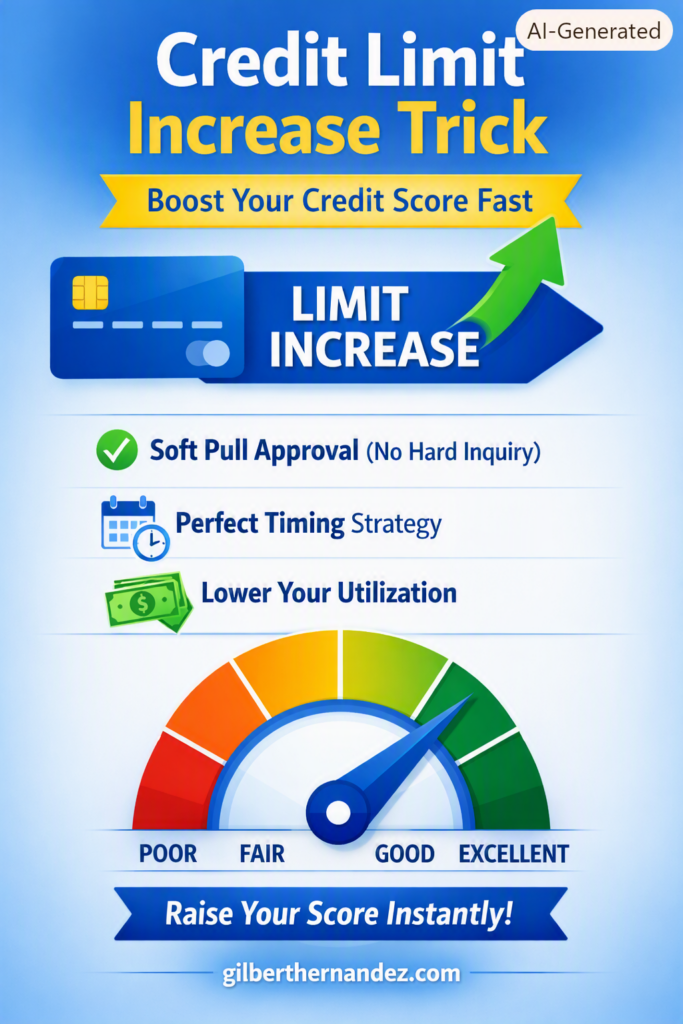
infographic showing credit limit increase, soft‑pull approval, timing strategy, and utilization drop.
Credit limit increases are one of the easiest ways to raise your credit score — and you don’t have to spend a dollar to do it. When your limit goes up, your utilization drops instantly, and that alone can trigger a 20‑ to 60‑point jump. The key is knowing how to request an increase the right way, at the right time, without taking a hard inquiry. This credit limit increase trick works fast because it lowers utilization instantly.
How This Credit Limit Increase Trick Works
Your credit score is heavily influenced by credit utilization — the percentage of your available credit you’re currently using. When your limit goes up, your utilization goes down, even if your balance stays the same. That’s why a limit increase can move your score overnight.
Example:
- $1,000 balance on a $5,000 limit = 20% utilization
- $1,000 balance on a $10,000 limit = 10% utilization
Same balance. Better score.
The Math Behind Utilization and Limits
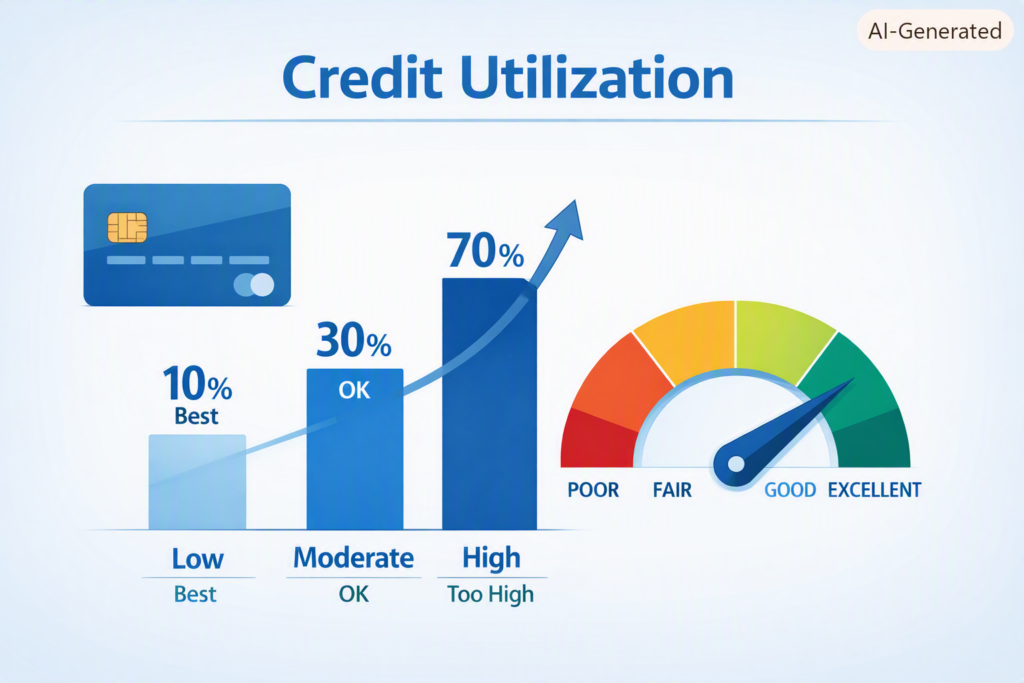
FICO and VantageScore both reward lower utilization. The best ranges are:
- 10% or lower → ideal
- 30% or lower → acceptable
- 70% or higher → score killer
A limit increase pushes you into better zones without paying anything down.
Soft‑Pull vs. Hard‑Pull Increases
There are two types of limit increases:
Soft‑Pull Increase
- No impact on your credit score
- Instant approval or denial
- Usually done online or in the app
Hard‑Pull Increase
- Shows up as a credit inquiry
- Can temporarily lower your score
- Often used by older banks or during manual reviews
Your goal is simple: get the soft‑pull increase.
Banks Known for Soft‑Pull Limit Increases
These lenders typically approve increases without a hard inquiry:
- American Express
- Discover
- Capital One
- Apple Card (Goldman Sachs)
- Navy Federal Credit Union
Most of these allow requests every 6 months.
Timing Your Request for Maximum Approval
Banks look at your recent behavior. You want to request an increase when your profile looks strongest:
- Your balance is low
- You’ve made on‑time payments for 3–6 months
- You’ve used the card consistently
- You haven’t requested multiple increases across different cards recently
The best time to request is right after a payment posts and your reported balance is low.
The “Double‑Dip” Method (Advanced)
Some banks allow a second increase immediately after the first — if your profile supports it.
Here’s how it works:
- Request a soft‑pull increase online.
- If approved, wait 30 seconds.
- Request again through the automated phone system or chat.
This doesn’t work everywhere, but when it does, you can double your limit in minutes.
Automatic Limit Increases
Some banks give automatic increases every 6–12 months if you:
- Use the card regularly
- Keep utilization low
- Pay on time
- Avoid maxing out the card
If you qualify, these increases happen without you asking — and without any inquiry. Most people never use this credit limit increase trick even though it’s one of the fastest ways to improve a score.
Final Takeaway
A credit limit increase is one of the fastest, easiest ways to raise your credit score. It costs nothing, takes minutes, and directly lowers your utilization. Request it at the right time, target soft‑pull lenders, and use the double‑dip method when available.
If you haven’t asked for a limit increase in the last six months, now is the time.
This limit increase trick is even more effective when combined with the utilization strategy I covered in Credit Utilization Hack.
Credit Utilization Hack: The Fastest Way to Boost Your Score
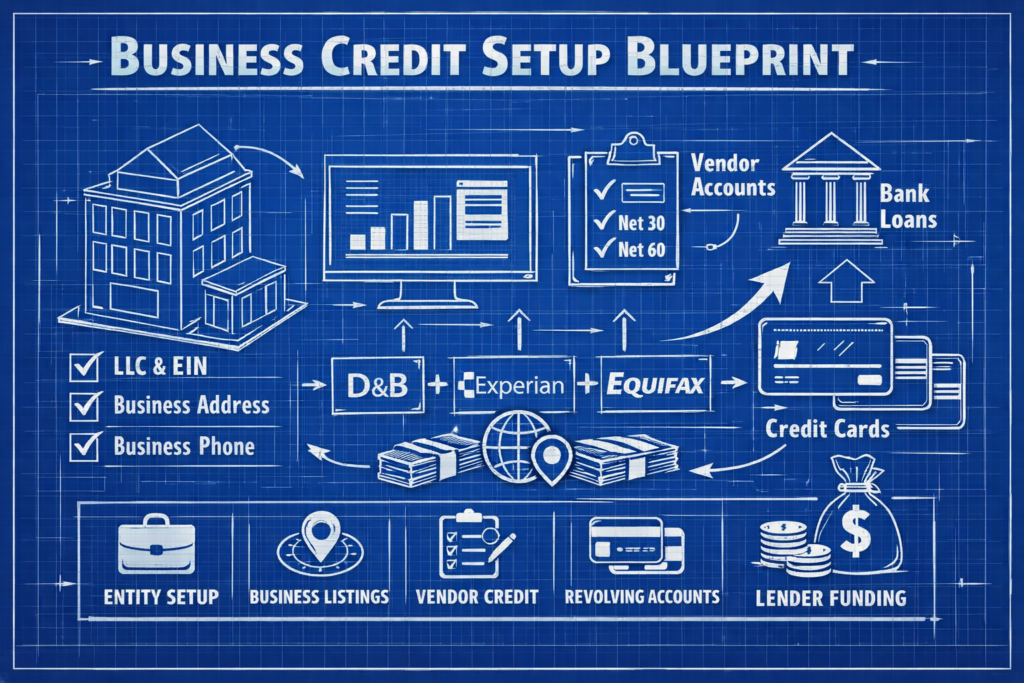
The Business Credit Setup That Makes Funding Predictable
How I Turned My Credit Into a Passive Income Engine
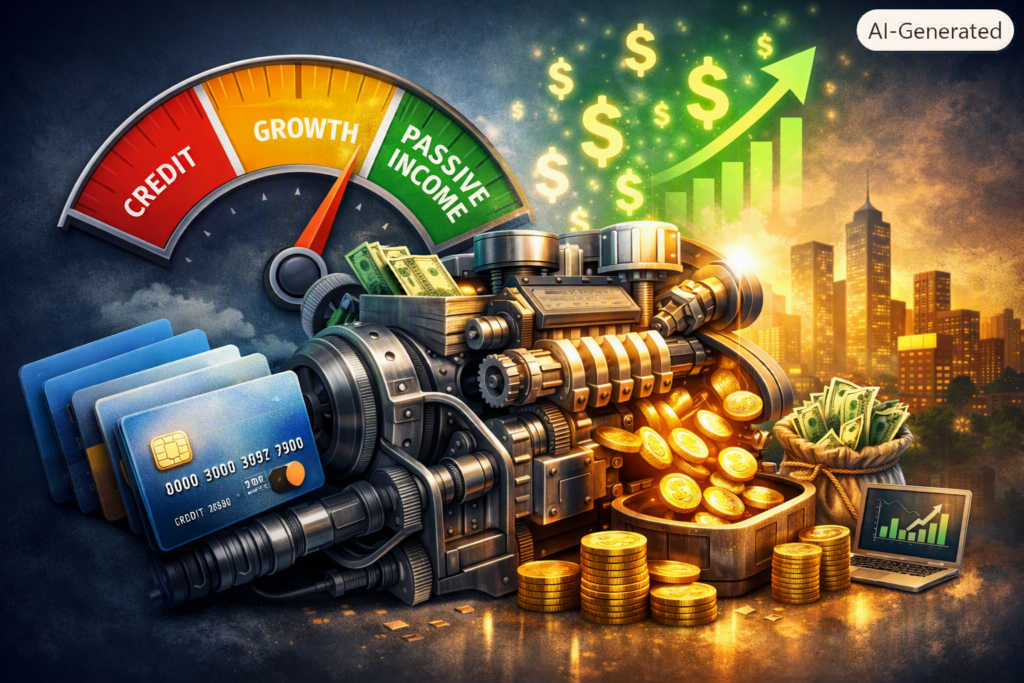 The Moment Credit Became an Engine
Most people think credit is something you use when you need money. I used to think the same — until I discovered that credit can become a mechanical system that produces passive income. Not through tricks, hacks, or complicated businesses, but through a repeatable rotation strategy that grows limits, reduces costs, and frees up cashflow. This is the story of how I turned my credit into a passive income engine.
The Core Idea: Credit Is a System, Not a Score
Credit isn’t just a number lenders look at. It’s a tool, and when used correctly, it becomes a system that expands your financial capacity. The moment I stopped treating credit like a score and started treating it like a mechanical engine, everything changed.
Here’s the shift:
- Credit → Capacity
- Limits → Fuel
- Payments → Rotation
- Utilization → Efficiency
- Banks → Suppliers
Once you see credit this way, you stop reacting to bills and start engineering outcomes.
The Rotation Strategy That Makes It Work
The engine runs on a simple rotation:
- Increase limits strategically
- Lower utilization mechanically
- Move balances into cheaper positions
- Free up cashflow
- Repeat the cycle
This rotation creates a predictable pattern:
- Your limits rise
- Your utilization drops
- Your score increases
- Your approvals improve
- Your interest costs shrink
- Your available capital grows
This is the moment credit stops being a burden and becomes an engine.
Where Passive Income Comes In
Once your rotation system frees up cashflow, you can redirect that cashflow into:
- High‑yield savings
- Short‑term lending
- Micro‑investments
- Business credit stacking
- Passive income systems
- Small digital assets (like blogs, micro‑sites, or directory sites)
The engine produces capital, and capital produces income.
You’re not working harder — you’re working with a stronger engine.
Why This Works Without a Complicated Business
Most passive income advice requires:
- A business
- A product
- A funnel
- A marketing system
- A team
- A brand
But a credit engine doesn’t require any of that.
It’s mechanical. It’s repeatable. It’s personal. It’s simple. It scales quietly in the background.
This is why I call it an engine — not a business.
The Result: A System That Grows While You Sleep
When your credit engine is running, you experience:
- Higher limits
- Lower interest
- Better approvals
- More available capital
- More passive income opportunities
- Less financial stress
It becomes a self‑reinforcing loop.
Credit → Cashflow → Passive Income → Better Credit → More Cashflow → More Passive Income
That’s the engine.
Anyone Can Build This Engine
You don’t need a complicated business. You don’t need a marketing funnel. You don’t need a team.
You need a credit system, a rotation strategy, and the discipline to run the engine.
This is how I turned my credit into a passive income engine — and how you can build yours too.
Credit Mechanics for Better Scores and Higher Limits
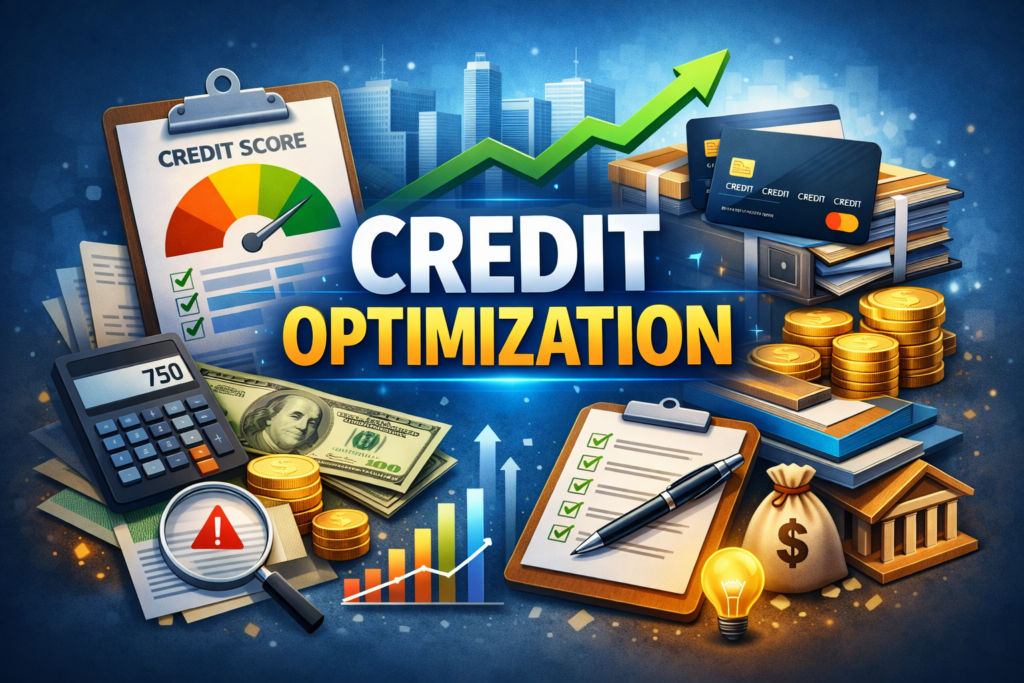 Credit optimization is the foundation of every financial system you build. When your credit profile is clean, structured, and predictable, lenders trust you. That trust turns into higher limits, lower utilization, and access to real funding. This page breaks down the mechanics of credit optimization in a simple, repeatable way so you can improve your score and position yourself for business credit later.
What Credit Optimization Actually Means
Credit optimization is the process of improving your credit score, increasing your limits, and removing negative items that slow down approvals. It’s not emotional. It’s mechanical. When you understand how lenders evaluate risk, you can adjust your behavior and get predictable results.
Key factors lenders look at:
- Payment history
- Credit utilization
- Length of credit history
- New inquiries
- Credit mix
These five levers determine how fast your credit grows.
Fastest Ways to Improve Your Credit Score
These actions create the biggest jumps in score:
- Lower utilization below 10–20%
- Pay down revolving balances before the statement date
- Remove inaccurate negative items
- Add positive payment history
- Increase limits to reduce utilization
- Avoid unnecessary hard inquiries
Credit optimization is about controlling these variables consistently.
How to Increase Your Credit Limits
Higher limits reduce utilization and increase lender confidence. The simplest ways to grow limits:
- Request credit limit increases every 90–180 days
- Use your cards lightly but consistently
- Keep old accounts open
- Build relationships with banks known for generous increases
- Maintain low utilization before asking for increases
This is the foundation for business credit later.
Preparing for Business Credit and Funding
Once your personal credit is optimized, you can leverage it to unlock business credit. This is where scaling becomes possible.
You’ll need:
- A clean personal credit profile
- Low utilization
- A business entity
- A business bank account
- A simple business model
- A plan for how you’ll use the capital
Credit optimization is the first step in building a funding‑ready business.
Common Mistakes That Slow Down Credit Optimization
Avoid these if you want fast results:
- Carrying balances month to month
- Closing old accounts
- Applying for too many cards
- Ignoring utilization
- Using credit emotionally instead of mechanically
Credit optimization works when you treat it like a system.
Conclusion
Credit optimization gives you control over your financial life. When your score improves, your limits grow, and your utilization drops, lenders trust you. That trust becomes funding. And funding becomes leverage. This page is your foundation for building a clean, predictable credit profile that supports everything else you want to scale.
The Credit Optimization System That Makes Scores Move

The blueprint curve represents how structured credit optimization creates predictable upward movement — a visual echo of the system that makes scores rise.
When I first started helping people fix their credit, I noticed something strange. Some people worked hard and saw almost no movement. Others made a few small changes and their scores jumped fast. At first, it looked random. But it wasn’t. There was a pattern hiding underneath the chaos.
That pattern became the credit optimization system.
It’s the same system I use today, and it works because credit scores don’t respond to luck — they respond to structure. Once you understand the triggers the algorithm reacts to, you can guide your score upward in a predictable way.
1. Stabilize the Profile
In the beginning, I watched people try to build their credit on shaky foundations. They paid things down at random, disputed whatever looked wrong, and hoped the score would rise. But hope isn’t a strategy. Stability is.
When your balances, behaviors, and reporting patterns stop sending mixed signals, the algorithm finally knows what to reward. This is the moment your score becomes ready to move.
2. Optimize Utilization
One client came to me frustrated. She had paid off several cards, yet her score barely moved. When I looked closer, I saw the problem: her utilization wasn’t structured. It was scattered.
Once we reorganized her balances — not just lowered them — her score jumped within days. That’s the power of optimized utilization. It’s the fastest lever in the entire credit system.
3. Build Strategic Accounts
Over time, I learned that not all accounts help you. Some stall your score. Some drag it down. And a few create powerful upward pressure. When you choose accounts strategically, your score starts climbing with less effort.
This step is where people often break momentum without realizing it. The wrong account can freeze your progress. The right one can accelerate it.
4. Trigger Score Movement
Once the foundation is stable and the utilization is optimized, the real magic begins. This is where you activate the score‑movement triggers — the actions that cause the algorithm to recalculate in your favor.
When these triggers are done in the right order, your score doesn’t just rise. It rises predictably.
5. Maintain the Upward Curve
The final step is simple: keep the system intact. When your profile stays optimized, your score continues rising month after month. This is how you create long‑term movement instead of temporary spikes.
I’ve watched this system transform credit profiles over and over again. Not because it’s complicated, but because it follows the same structural rules the algorithm already uses.
If you want predictable score movement, you need a predictable system. This is the one that makes scores move.
The Utilization Trick That Boosts Credit Scores Overnight
Most people try to improve their credit score by paying more money, disputing errors, or opening new accounts. But the fastest score boost comes from something much simpler: controlling the balance your bank reports to the credit bureaus. This utilization trick can raise your score overnight without changing your spending or paying off everything at once.
Credit utilization is the percentage of your available credit that appears to be in use. The formula is simple:
Reported Balance ÷ Credit Limit = Utilization
Example:
• Credit Limit: $10,000
• Reported Balance: $4,000
• Utilization: 40%
The key word is “reported.” Your real balance doesn’t matter—only the number your bank sends to the credit bureaus.
Banks report your balance on the statement closing date, not the due date. If you pay down your balance before the closing date, the bank reports a lower number, and your credit score jumps. Utilization makes up about 30% of your FICO score, so lowering it creates an instant score increase.
You can find your statement closing date in your online account under “Statements,” your PDF statement, or your mobile banking app under “Billing Cycle.” Once you know this date, you can control exactly what gets reported.
Here’s the mechanical workflow:
1. Check your current balance.
2. Find your statement closing date.
3. Pay down the balance 48 hours before that date.
4. Let the bank report the lower number.
5. Watch your score increase within 24–72 hours.
Typical score jumps:
• 10–20 points for small balances
• 20–40 points for moderate balances
• 40–60+ points for high utilization cards
If multiple cards report lower balances at the same time, the effect stacks.
You don’t need to pay everything off. You only need to reduce the reported balance.
Example:
• You owe $4,000
• You pay $2,500 before the closing date
• Bank reports $1,500
• Utilization drops from 40% to 15%
• Your score jumps
You can pay the remaining balance later on the due date. The trick is about timing, not perfection.
If you have multiple credit cards, optimize in this order:
1. Cards with the highest utilization
2. Cards with the lowest credit limits
3. Any card reporting above 30% utilization
This gives the fastest score improvement with the least cash.
Goal: Build Business Credit (Checklist)
This checklist is being built with ai and my experience.
Some things to expect, based on my needs and wants, are simplicity and ease of execution.
My “business” consists of 2 parts, one is a digital product that shows you how to build business credit starting with building the business the right way to get credit and how you could use the credit to acquire profit producing assets that pay for themselves while earning you a healthy return.
as I am writing this I can see how I am trying to kill too many birds with only one stone.
do have some ideas on checklists for the multiple parts of my plan.
let me do a little more breakdown of what’s coming, the steps I am taking to have a business with more than $250k in credit lines.
My personal credit needs a tuneup and will be step one and needs its own list.
Guess a link to the checklists will be needed, I better put that on my list!?
I know that word has a way to create a fillable checklist maker. Google most likely does too.
another item for my list.
Does this concept interest you?
Do you want lists that I go through and document the results?
let me know your thoughts in the comments below, I read them all!
Exploring the Benefits of a Business Checklist System
A business checklist system is the simplest way to turn scattered tasks into predictable results. Most people try to run their day from memory, and then wonder why things slip, stall, or never get finished. A checklist removes the guesswork and replaces it with structure.
Here’s why a mechanical checklist system works so well.
Why a Business Checklist System Works Better Than Memory
Memory is inconsistent. Systems are consistent.
A checklist forces clarity. It shows you exactly what needs to be done, in what order, and without emotional interference. Because of this, a business checklist system becomes a tool you can rely on even when your energy, motivation, or focus fluctuates.
When you operate from a checklist, you eliminate decision fatigue and reduce the mental load that slows you down.
Checklists Reduce Errors and Increase Accuracy
Mistakes happen when you rely on recall. A checklist prevents that.
Pilots use checklists. Surgeons use checklists. Investors use checklists. They do this because structured steps reduce risk. When you follow a repeatable sequence, accuracy increases automatically.
This is why every strong business checklist system becomes a safeguard against oversight.
Checklists Create Repeatable Success
Success is not random — it’s repeatable.
A checklist turns a one‑time win into a repeatable process. When you know the exact steps that produced a result, you can run those steps again tomorrow, next week, and next month.
This is how habits form. This is how systems scale. This is how businesses grow.
Checklists Remove Overthinking and Underthinking
Most people either overthink (too many ideas, no action) or underthink (act without structure). A checklist solves both problems.
It gives you a clear path forward, which means you don’t have to wonder what to do next. You simply follow the sequence. Because of this, your daily execution becomes smoother and more predictable.
Checklists Build Momentum Automatically
Momentum doesn’t come from big moves. It comes from small actions done consistently.
A business checklist system ensures those small actions happen every day. When your checklist runs, your results compound. When your checklist stalls, your results stall.
This is why checklists are one of the simplest tools for building long‑term momentum.
Checklists Make Delegation Easier
If you ever want to hand off tasks, a checklist becomes the training manual.
Instead of explaining things repeatedly, you give someone the steps. They follow the system. The output stays consistent. This is how you scale without losing quality.
Checklists Turn Chaos Into Clarity
Chaos comes from uncertainty. Clarity comes from structure.
A checklist organizes your day, your workflow, and your priorities. It shows you what matters and what doesn’t. It keeps you focused on the actions that move the needle.
This is why checklists are foundational for anyone building a business, improving credit, or creating income systems.
Final Takeaway
A checklist is not a piece of paper. It’s a mechanical system that removes guesswork, reduces errors, builds momentum, and creates repeatable success. When your business checklist system runs daily, your results become predictable.
If you want more examples of structured systems, explore my Checklists That Work series — it breaks down the exact mechanics behind effective daily execution.