Private Money Lending Rates: What to Expect in 2026
 One of the first questions real estate investors ask about private money is: “How much does it cost?” Understanding private money lending rates helps you accurately analyze deals and negotiate better terms. Here’s a complete breakdown.
What Are Typical Private Money Lending Rates?
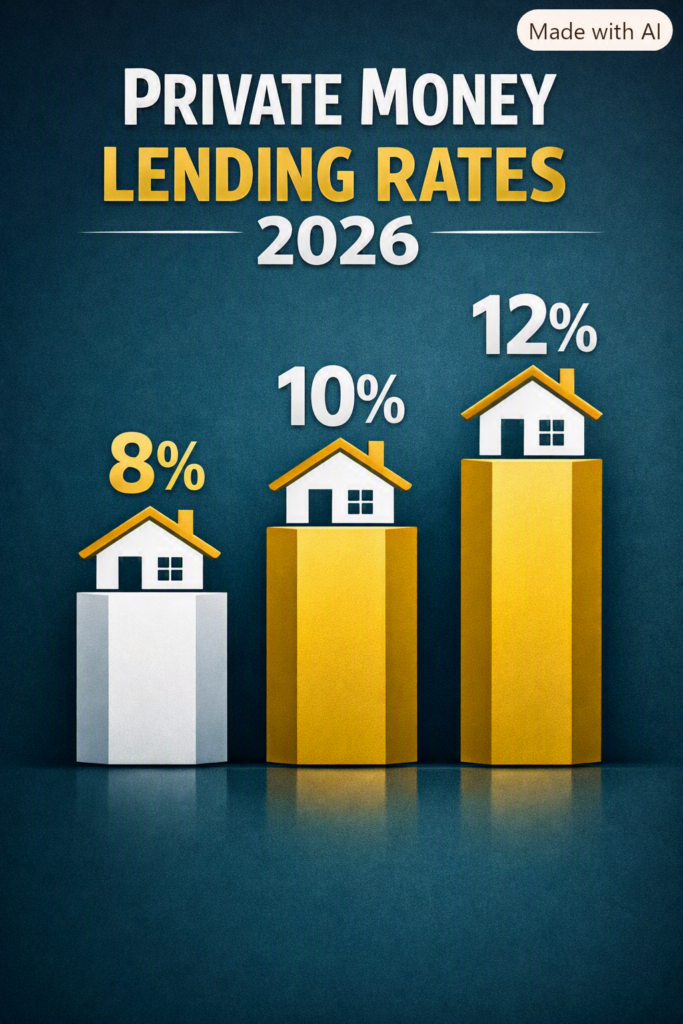
In 2026, private money lending rates typically range from 8% to 13% annually, depending on:
- The lender’s risk tolerance and relationship with the borrower
- The property type and condition
- The loan-to-value ratio (LTV)
- The loan term and exit strategy
- The borrower’s track record
Interest Rate Breakdown by Property Type
- Fix-and-Flip (residential): 9–12%
- BRRRR Rentals: 9–11%
- Commercial Bridge: 10–13%
- Land Loans: 10–14%
- New Construction: 10–13%
What Are “Points” in Private Lending?
Points are origination fees charged upfront. One point = 1% of the loan amount. Private lenders typically charge 1–3 points. On a $200,000 loan at 2 points, you’d pay $4,000 at closing.
How LTV Affects Your Rate
The lower your LTV, the lower your rate. A 60% LTV loan carries less risk than an 80% LTV loan—lenders reward less risk with lower rates. Most private lenders cap LTV at 70–75%.
How Borrower Track Record Affects Rate
First-time borrowers typically pay higher rates (10–12%). Repeat borrowers with a proven track record often negotiate down to 8–9%. Your credibility has real monetary value.
Comparing Private Money to Hard Money
Hard money lenders typically charge 11–14% with 2–4 points. Private individual lenders often charge 8–10% with 1–2 points. Over a 12-month, $200,000 loan, that difference is $6,000–$8,000 in savings.
How to Negotiate Better Rates
- Bring a strong deal with conservative numbers
- Show your track record and references
- Offer a lower LTV (more equity cushion for the lender)
- Offer a personal guarantee
- Start with one solid deal and build the relationship
Are Private Money Rates Worth It?
Yes—when the deal math works. If you’re buying a property at $0.70 on the dollar with strong ARV, the 10% interest rate is a cost of doing business, not a dealbreaker.
Want to learn how to structure a deal around these rates? Read how to structure a private money lending deal and how to analyze a fix-and-flip deal.
Leave a Reply